





- About Us
- Legacy and Reach
- R & D Centers Of Excellence

Our R&D centres of excellence play a pivotal role in accelerating growth, driving progress and advancing the industry with cutting-edge research. Equipped with world-class facilities and scientific expertise, it enables continuous breakthrough innovations, unlocks future growth and creates value-added solutions across operations.
Our world-class centre delivers excellence across operations

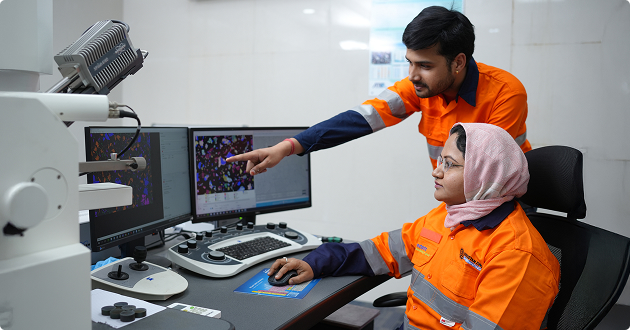
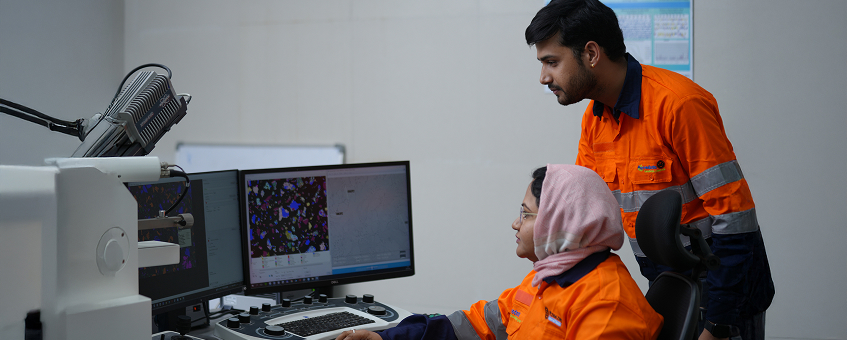
Our mineralogy laboratory is equipped with advanced analytical tools, including a Field Emission Scanning Electron Microscope (FESEM), X-ray Diffractometer (XRD), and X-ray Fluorescence (XRF) spectrometer. These instruments enable high-resolution imaging, precise phase identification, and rapid multi-elemental analysis of geological and mineral samples, respectively. The lab supports detailed mineralogical investigations essential for ore characterisation, process development, and quality control. Whether for academic research, industrial applications, or exploration projects, our facility delivers reliable insights into mineral composition, structure, and behaviour. Thus, it empowers smarter decisions in mineral processing and resource management.
Facilities offered
- Microscopy, mineralogy and chemical analysis
- FESEM-EDX (Mineralogic)
- XRD
- XRF
- Optical Microscope
- Sample preparation
- Quorum sputter coater
- Polishing equipment
- Sample cutting equipment
Our mineralogy laboratory is equipped with advanced analytical tools, including a Field Emission Scanning Electron Microscope (FESEM), X-ray Diffractometer (XRD), and X-ray Fluorescence (XRF) spectrometer. These instruments enable high-resolution imaging, precise phase identification, and rapid multi-elemental analysis of geological and mineral samples, respectively. The lab supports detailed mineralogical investigations essential for ore characterisation, process development, and quality control. Whether for academic research, industrial applications, or exploration projects, our facility delivers reliable insights into mineral composition, structure, and behaviour. Thus, it empowers smarter decisions in mineral processing and resource management.
Facilities offered
- Microscopy, mineralogy and chemical analysis
- FESEM-EDX (Mineralogic)
- XRD
- XRF
- Optical Microscope
- Sample preparation
- Quorum sputter coater
- Polishing equipment
- Sample cutting equipment
Our patented innovations
12
Patents filed
11
Patents Granted
Full list of granted and filed patents
| Sr. No. | Highlighted granted Patents list | Patent No |
|---|---|---|
| 1 | Method for the production of lead by performing dross removal procedures | IN 468077 |
| 2 | Method for the production of zinc by utilising lead plant slag | IN 476200 |
| 3 | Method for recovery of metal values from industrial waste | IN 476226 |
| 4 | Method for manufacturing paver blocks and bricks from industrial waste | IN 530897 |
| 5 | System for scrapping of silver from cathode plates | IN 541547 |
| 6 | A process for the recovery of valuable base metals from mineral beneficiation process tailings | IN 271771 |
| 7 | A process for recovery of valuable metals from hot gas precipitator (hgp) dust | IN 271776 |
| 8 | Method and system for production of potassium antimony tartarate by utilising antimony-bearing residue, | IN 397312 |
| 9 | Method and system for production of potassium antimony tartarate by utilising antimony-bearing residue | EP 3192882 |
| 10 | Method and system for production of potassium antimony tartarate by utilising antimony-bearing residue | US 10919924B2 |
| 11 | Method for manufacturing of paver blocks and bricks from industrial waste | US 10844551B2 |
Real solutions, delivering real impact

Sodium cyanide has traditionally been employed as an effective Fe-sulfide depressant in the differential flotation of lead-zinc (Pb-Zn) ores. Despite its efficiency, the reagent poses substantial health, environmental, and operational hazards due to its acute toxicity and stringent handling requirements. To address these challenges, this project investigated a range of non-toxic alternative iron depressants for use in Pb-Zn flotation processes. Following extensive laboratory trials, humic acid salt emerged as the most effective and environmentally benign alternative. This innovative solution was successfully implemented at RAM in October 2023. The idea was presented at various technical platforms and was selected as 'Excellent Environment Project' by CII 2025.
The technology has been filed for patent protection under Indian Patent Application No. 202311038974.
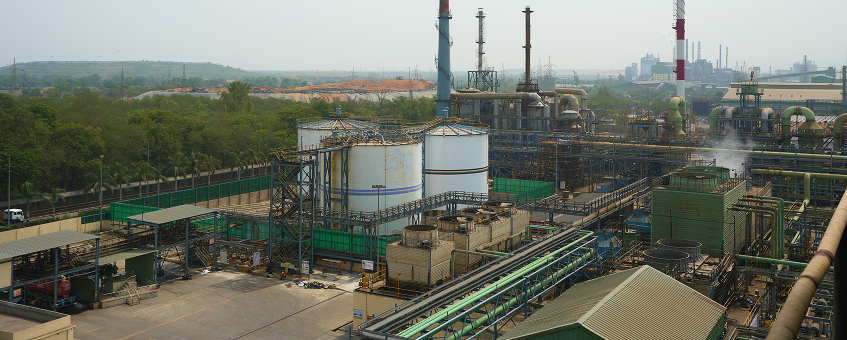

Maintaining consistent ZnSO₄ quality in the zinc electrowinning cell house remains a significant operational challenge. Variations in key process parameters, such as Zn concentration, acidity, feed temperature, organic additives, metal impurities, and feed flow, can alter its cathodic polarisation. These fluctuations directly impact current efficiency (CE), energy consumption, and the quality of the final zinc product. Polarisation behaviour in the electrolyte feed can be quantified by the electrochemical parameter overpotential (OP).
This project describes an apparatus for real-time measurement of overpotential in zinc electrowinning circuits. The system enables plant operators to quantitatively assess and monitor the influence of dynamic process variables on electrolyte quality, thereby allowing timely interventions to optimise electrowinning performance.
The technology has been filed for patent protection under Indian Patent Application No. 202511029946.
Xanthate-based collectors are the industry standard for Pb-Zn flotation due to their strong affinity for sulphide minerals. However, they exhibit limited selectivity toward silver-bearing phases, often resulting in suboptimal silver (Ag) recoveries in conventional concentrator circuits.
To enhance Ag recovery, this project focused on identifying more selective Ag-collecting reagents that can be integrated into existing Pb-Zn flotation schemes. A series of potential promoters, e.g., phosphate, phosphinate, and thiocarbamate chemistries, was systematically evaluated through laboratory-scale flotation tests.
Dithiophosphate-based promoters demonstrated superior selectivity and recovery efficiency for Ag minerals under standard flotation conditions. Based on these results, plant-scale trials were conducted at our concentrators, confirming the reagent's effectiveness in enhancing Ag recovery without any adverse impact.
Following successful validation, the dithiophosphate promoter was fully implemented at RAM & ZM concentrators.
A patented process has been developed at our R&D centre to produce Potassium Antimony Tartrate (PAT) by utilising antimony-bearing residues. This process involves treating the antimony-bearing byproducts of zinc-lead smelters and converting them into a value-added product, potassium antimony tartrate. Zinc hydro smelters are consuming PAT for the purification of zinc sulphate solution to produce zinc metal.
Our R&D centre has pioneered the manufacturing of high-strength paver blocks and bricks by valorising the smelter waste such as Jarosite, slags, and fly ash. This innovative process transforms waste into a valuable green product, conserving natural resources and supporting a circular economy by reducing landfill waste and need for virgin materials mining. It provides an economically viable and sustainable solution for civil construction applications.
Our paste fill technology utilises fly ash or ultra fly ash as an alternative binder to partial replacement of cement in underground mine backfilling. This initiative significantly reduces cement consumption, conserves resources and reduces greenhouse emissions. Furthermore, this circular approach improves economic viability and strengthens our carbon credit portfolio.
The R&D team has an in-house fabricated controlled monitoring system for detecting O2 level in the high-temperature furnace off-gas, capable of operating under dusty and acidic conditions. Through this technique, the sole purpose is to measure and predict furnace oxidising efficiency when sulfidic ores are treated.
The technology has been filed for patent protection under Indian Patent Application No. 202411006484.
We generate a considerable amount of pyrometallurgical slags as a by-product of lead smelting, containing a good amount of zinc, which in most cases goes for landfilling purposes. The slags have been collected, characterised, and lab-scale tested at our in-house rotary kiln. Upon obtaining the desired Zn-oxide in output, the same has been treated in a plant-scale rotary furnace. To date, 1.3kT have been treated, yielding doubled Zn-oxide production. The problem statement has been discussed on multiple national and international platforms and awarded as an 'Excellent Environment Project' by CII 2025.